
Morristown Previous Residents by Era
Different records cover different parts of a Morristown address history. The first task is to choose the source that fits the year in question, then record what that source can actually establish. Recorded-property material is useful for transfers. Directories and newspapers can supply historical appearances. Maps help test whether the street, structure, or parcel context still lines up. None of those sources alone proves every person who lived at an address.
| Source | Years It Covers | Where Held | What It Shows |
|---|---|---|---|
| Morris County Clerk online property index | 1960 forward | County Clerk public search | Recorded instruments, party roles, recording data, and possible linked images |
| Records Vault property material | Late 1700s through the pre-1960 period | Morris County Clerk Records Vault | Older books, microfilm, and digital images of property records |
| Morristown city directories | 1885-1982, with gaps | North Jersey History and Genealogy Center | Dated listings for people, businesses, and organizations |
| Federal census | 1790-1950 public schedules | National Archives and library research access | Household evidence that needs address and district reconciliation |
| Historic maps and Sanborn sheets | 1868, 1887, 1909, and 1910 examples | Library collections and Library of Congress | Street, lot, footprint, and building context, not a resident list |
For a recent transfer, begin with the deed index and then move back one instrument at a time. For an earlier household question, begin with the nearest directory edition and use a census decade, map, newspaper, or deed to test the match. Keep a blank space in the timeline for years without a source. A gap is evidence of incomplete coverage, not proof that a family moved.
Morristown Address Records First
Before tracing past residents, anchor the property with the Morris County tax search or GIS context. The county tax search separates its routes by property location, owner, block and lot, and prior block and lot. Each route uses a tax year and district. That makes the tax record a good place to capture the current street form, municipality, tax identifiers, and the date of the displayed information before comparing older sources.
The Morris County GIS applications add parcel geometry and address context. Their parcel data can help a researcher spot a split parcel, a changed lot number, or a location that falls outside the expected municipality. The county warns that tax data may be revised and that GIS layers are not a survey, legal boundary, or tax map. Treat those tools as matching aids. A tax owner field does not establish that the owner occupied the house, and a parcel outline does not replace the legal description in a deed.
Note: Preserve the tax year, district, block, lot, and street spelling before carrying an address backward.
Morristown Deed Trail for Past Residents
The Morris County Clerk records deeds, mortgages, liens, maps, and related instruments. Its public property-record search is a document index, not a people directory. It offers Party Name, Instrument Number, Book/Page, Town, Lot/Block, Map Number, Parcel ID, Legal Description Line 1, and other routes. A result can include recording date, book and page, consideration, parcel references, direct and indirect party labels, and linked documents. Images may be restricted or require login.
Use the deed chain to document transfers, not occupancy. The following Morris County Clerk public-search view shows the property-record search interface used to begin a party and instrument trail.
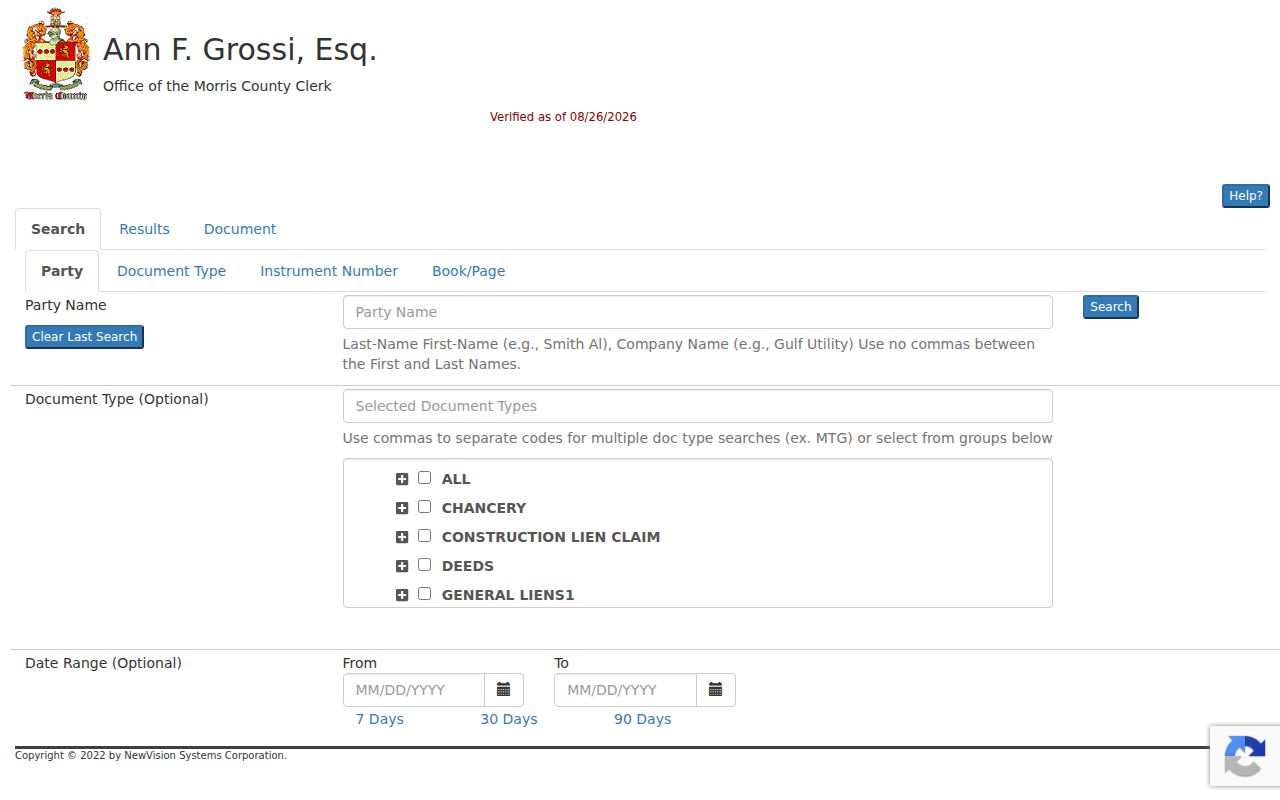
The displayed search modes help connect a dated deed to its book/page or parcel reference. Save those identifiers with the result so an earlier deed can be checked rather than inferred from a similar surname.
- Use the tax or GIS record to capture the address, municipality, block and lot, and any deed book/page or deed date shown.
- Search the present recorded party or the known Book/Page in the Clerk index, then open the matching instrument details.
- Read the deed for the transferor and transferee, recording date, legal description, and linked instrument references.
- Search the prior transferor as a grantee, or use the earlier book/page, to find that party's purchase.
- Repeat one documented link at a time. When the trail reaches the online cutoff, move to the Records Vault rather than guessing an earlier owner.
- Grantor
- The party conveying an interest in the recorded instrument.
- Grantee
- The party receiving the conveyed interest in that instrument.
- Chain of title
- A documented sequence of transfers connected by recorded instruments, not a list of presumed occupants.
- Legal description
- The parcel language in a deed, often more reliable than an old street number when lots were split or street forms changed.
Morristown Previous Records Before 1960
The Clerk says its online property records reach back to 1960. Pre-1960 work belongs with the Morris County Records Vault, which describes books, microfilm, and digital images reaching into the late 1700s. That distinction matters when tracing previous residents because a modern index may stop in the middle of a valid deed chain. A blank online result may simply mean the next document is held in an older format.
A mail request to the Vault should give a general description and, when known, a book/page, return address, and payment. The research identifies non-certified copies at $2 per page, certified copies at $1 per page plus $10 certification, and $1 postage without a self-addressed stamped envelope, but the county fee page should be checked before requesting copies. The Vault also routes marriage and divorce research differently, so a property-record inquiry should stay focused on the requested land record.
New Jersey State Archives historical-record collections are a separate route when a date or record series calls for state archival research.
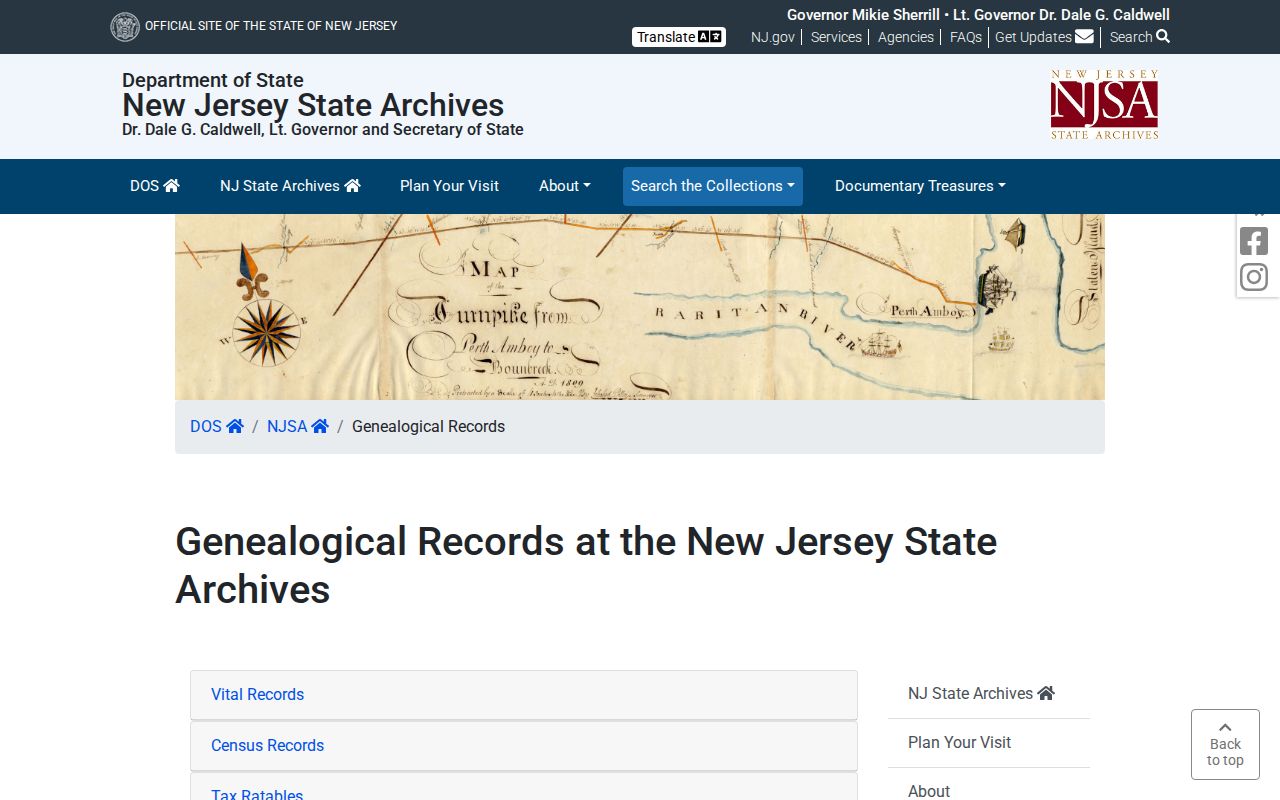
Archives, the Records Vault, and the local library hold different materials. Identify the record type and its date before contacting each custodian.
Morristown Past Address Records on Maps
Morristown research did not locate an official broad street-renumbering or street-renaming history. That is a reason to compare sources, not to silently convert an old address into a modern one. Transcribe the historic street spelling, abbreviation, and house number first. Then test it against the 1868 Beers map, 1887 Robinson map, 1910 Mueller map, city directories, tax maps, and the deed's legal description.
The library's house-history guidance recommends an appointment so staff can retrieve noncirculating material from storage. Its map index has more than 10,000 maps for Morristown, Morris Township, and parts of Morris County. The Library of Congress 1909 Morristown Sanborn set has 44 images. A Sanborn sheet can help compare a building footprint, frontage, adjoining structures, and street context. It does not name every person who lived there or substitute for a present safety or code inspection.
Note: Mark a suspected renumbering or parcel split as unresolved until a map, deed, or custodian reference supports it.
Morristown Past Residents in Directories
The Caroline Rose Foster North Jersey History and Genealogy Center at the Morristown and Morris Township Library holds Morristown city directories from 1885 through 1982, with gaps, and Morris County directories from 1897 through 1909. The exact reel and call-number groupings are in the library's directory finding aid. A directory appearance is a dated historical listing. It may show an address, occupation, organization connection, or household style, but it should not be stretched into proof that someone owned the property or remained there after that edition.
Pairing a directory with a federal census gives the household trail a second date anchor. Census schedules are household records organized through enumeration districts, not a guaranteed street-address lookup. Use the spelling and address form from the directory to find the right district and household, then compare names, dates, and nearby places. Do not claim a census is address-specific until the address can be reconciled from the source itself.
- Choose the directory edition nearest the date of interest and copy its full title, year, page, name form, and address exactly.
- Check the closest earlier and later volumes, including regional titles that join Morristown with nearby towns.
- Match the relevant census decade by place and enumeration district, preserving its own date and citation.
- Test the pairing with a deed, map, newspaper, obituary, or probate record before treating names as the same household.
The larger historical collection, including the library's newspapers, maps, and microform, is described on the Morristown city directories page.
Morristown Resident Clues in News and Maps
Newspapers can bridge years that lack a surviving directory. The library lists the Daily Record from 1900 to the present and the Genius of Liberty/Morristown Herald from 1798 to 1811 with gaps, alongside other local and regional titles. Notices may point to deaths, marriages, sales, tax lists, or organizations. A notice is a useful contemporaneous lead, but it remains a source-specific statement that should be checked against a deed, directory, map, census, or probate record.
For a house timeline, write down the newspaper title, issue date, page, exact name form, and the event described. Then set that item beside the nearest directory and map. This small habit prevents a familiar surname or an address fragment from becoming a false connection between Morristown past residents.
Morristown Records Requests by Parcel
When a property trail reaches a municipal permit, inspection, approved board minute, or code file that is not publicly searchable, a focused request under the New Jersey Open Public Records Act can be appropriate. Morristown's municipal OPRA route requires a written request to the proper custodian. Use the Town's form and name the address or block and lot, record type, department, and date range. An identifiable request is more useful than a broad demand for everything tied to a person.
The Town says requests generally receive a response as soon as possible and ordinarily within seven business days, subject to exceptions and extensions. Inspection has no listed fee, electronic copies are free, and printed-copy rules can change by format. Personnel material, police investigations, assistance files, confidential information, and deliberative material are among the listed exempt categories. Expect responsive records to be redacted where required.
Morristown Previous Resident Source Ladder
Keep the evidence in order: directory and exact year, newspaper, map, deed, tax record, census, Sanborn sheet, and current parcel. The sequence may change when a known deed book/page or map reference provides the better starting point, but every step should preserve the original wording, date, keeper, page or instrument number, and a confidence note. The Town, County Clerk, Records Vault, Library, Archives, and state systems share custody rather than forming one master file.
Redaction and portal limits belong in the notes as well. A missing owner display can reflect Daniel's Law, a restricted image may require authorized access, and a dynamic portal control should be recorded by the label visible at the time. The Morris County property-alert service is a useful present-day notification layer for a property owner, but it is not a title search and does not guarantee that every improper filing will be stopped.
The most reliable account of who lived here before is modest about what each record shows. It connects sources where they agree and leaves unresolved links plainly marked.