
Morristown City Directory Holdings
The Caroline Rose Foster North Jersey History and Genealogy Center at the Morristown and Morris Township Library is the key local shelf for historical names and addresses. Its published holdings list the Morristown run from 1885 through 1982, plus Morris County directories from 1897 through 1909. The local finding aid is the practical starting point because it identifies exact years and reel or call-number groupings. The runs have gaps, overlapping tables, and duplicate years, so a listed span is not proof that every annual volume survives.
| Collection | Years | Where Held | Access |
|---|---|---|---|
| Morristown printed directory run | 1885-1982 | North Jersey History and Genealogy Center | Consult the finding aid and request the relevant item onsite |
| Morris County directories | 1897-1909 | North Jersey History and Genealogy Center | Library holdings; many listed databases are available only inside the library |
| Morristown and nearby-town directory books | 1885-86, 1887-88, 1896-97; 1912-13, 1917, 1919-20 | North Jersey History and Genealogy Center | Check the shared title and call number before requesting a volume |
| Morristown High School yearbooks | Beginning in 1910 | Morris County Historical Society | Ask the Society about item-level access and permissions |
These are historical reference collections, not a current household list. A directory appearance establishes only that a person, business, or organization was recorded in that particular edition. For a move across a town line, the combined Morristown and Dover books and later regional titles can be especially useful because their headings include nearby communities.
Morristown Directory Years
The Morristown runs begin with 1885-86, 1887-88, 1896-97, and 1897-98, then continue through individual issues and longer stretches into the twentieth century. The finding aid lists examples such as 1903, 1904-05, 1907, 1908-09, 1911, 1914, 1915-16, 1918, 1920, 1922, 1924, 1926, 1927, 1930, and 1951 in one grouping. A larger list extends to 1982. Comparing the edition before an event with the edition after it is more reliable than treating a missing year as evidence of a move.
- 1885-86: earliest Morristown directory year identified in the local run.
- 1903: the New Jersey State Library bibliography identifies Richmond's Morristown Directory.
- 1912-13 to 1919-20: regional books join Morristown with Madison, Dover, Rockaway, Wharton, and Morris Plains in selected years.
- 1923-1982: the library house-history guide identifies directories with public information about individuals, businesses, and organizations in nearby towns during this span.
- 1982: latest Morristown year stated for the library's city-directory holdings.
Richmond titles matter because a publisher and town combination can explain why the same person seems to vanish from a Morristown-only search. Record the full title, date, and page, not merely the year, before treating two similar entries as the same household.
Morristown Directory Reel Tip
Start with the closest directory before and after a known event, such as a marriage, death, school year, or recorded deed. The local finding aid has overlapping runs and call-number groupings, so ask for the exact reel or item rather than a broad date range. Research notes identify MF DI 0036 and HM6 as examples of the kind of item reference worth preserving. A page number and a reel or call number make a later check much easier.
The same caution applies to title changes. Morristown appears by itself in some books and beside other Morris County places in others. A surname can be listed under a nearby community without showing that the person changed residence, so the edition's coverage area belongs in every research note.
Morristown Local History Access
The North Jersey History and Genealogy Center is at the Morristown and Morris Township Library, 1 Miller Road. Its local resources include directories, newspapers, maps, vertical files, family papers, oral histories, census material, microform, local organization records, historic-preservation surveys, and rare books. The library lists 973-538-6161 as its main number, while the Center contact is 973-538-3473 and njhgc@mmt.mainlib.org. The Center overview and its research database list help identify the collection before a visit.
For a house or address question, the library's house-history guidance strongly recommends an appointment. Staff may need advance notice of the topic and record type to retrieve materials from storage. The onsite material is noncirculating. Those access limits are useful planning information, not a reason to assume an item is unavailable.
Morristown Digital Records Holdings
The library's digital collections landing page is a separate online companion to the physical directory shelf. It brings together local photographs, maps, postcards, yearbooks, oral histories, and archival material that can help place a name or address in context. It should not be described as a digitized Morristown directory run. The research located no official digitized Morristown criss-cross directory, and a volume or reel still needs an onsite check before its arrangement can be described.
The Morristown library digital collections provide the online context for many local-history searches.
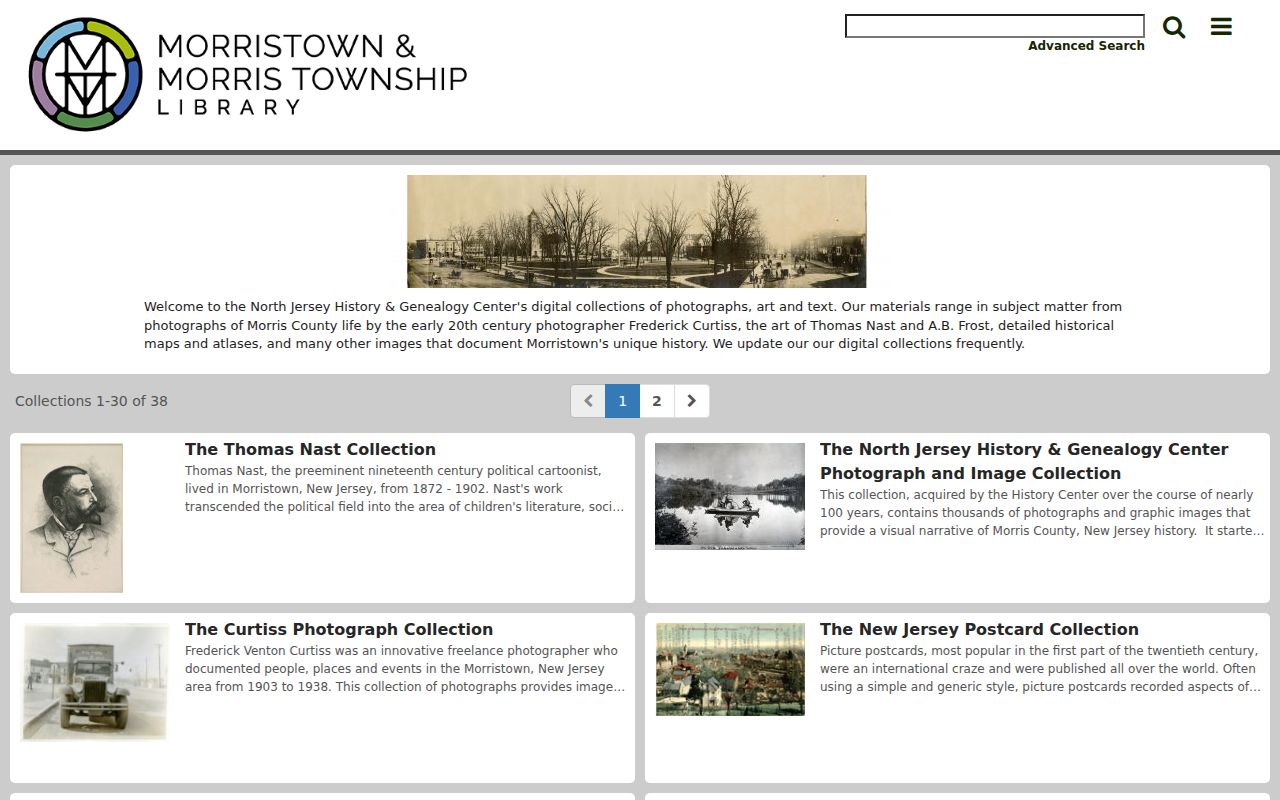
These digitized maps, photographs, yearbooks, and oral histories can add place and date context without replacing the cited directory edition.
The Morris County Historical Society collections provide another companion source. The Society holds nearly 15,000 items, including local business and legal materials, family and business archives, atlases and maps, military material, and Morristown High School yearbooks beginning in 1910. Ask the Society about the relevant item and any permission conditions.
Decoding a Morristown City Directory
Do not assume a fixed local directory layout from a generic directory example. The reviewed online material did not expose a Morristown entry page, so the order of fields, symbols, and abbreviations must be confirmed in the specific onsite volume or reel. The useful practice is to record what the edition actually shows, including its full publication title, year, and page, then preserve the original spelling and punctuation.
| Publication and year | Identifies the edition being cited and keeps similarly named books separate. |
|---|---|
| Page and alphabetical heading | Lets another researcher return to the same part of the volume. |
| Person or household name | Record it as printed, including initials or spelling variants. |
| Address | Capture the street form and number exactly as printed before comparing later sources. |
| Business or organization notation | Record a notation only when it appears in that edition. |
| Cross-reference | Note any pointer to another name, address, or section that the volume supplies. |
- Criss-cross directory
- When a volume labels a section this way, it is arranged by street or address rather than by a personal name. No official digitized Morristown criss-cross directory was located in the reviewed sources.
- Householder index
- An index that groups a street address under a household head when the particular volume provides one. Confirm its presence in the edition, rather than assuming every Morristown book has it.
- Abbreviation key
- A legend supplied by the publisher for shortened terms or symbols. Copy the key from the same volume before interpreting an abbreviated entry.
Morristown Newspapers Between Directories
A directory gap does not need to end the trail. The library's historical collections include local newspapers, and its newspaper guide identifies the Daily Record from 1900 to the present, along with earlier and regional titles. Local newspapers can carry deaths, marriages, sales, notices, and tax lists. A notice can place a family or business in a year where a directory is missing, but it remains a contemporary lead that needs a check against another source.
Use the library research sources and databases list to identify the title and date span. Then compare an item with the nearest directory, map, deed, census, or organization record. A notice should never be stretched into proof of every fact about a household.
Note: Keep the newspaper title, issue date, page, and exact name form with the directory citation for later checking.
Morristown Courthouse Records Geography
Morristown's county-seat history helps explain why related material can sit with different custodians. The historic courthouse was built in 1827 and originally held Clerk, Surrogate, and Sheriff offices, including a fireproof record room. Later facilities included the 1969 Hall of Records, the 1971 Ann Street annex, and the 1989 Administration and Records Building. The County's 2026 courthouse exhibit describes a longer public-history sequence reaching back to the first log courthouse in 1755.
That history is a records map, not a promise that every series is in one building. The Morris County Archives is a separate research route for older court and land-related material, while the library and Historical Society retain local collections of a different kind. Identify the record type and date before contacting a custodian.
Tracing Morristown City Directory Households
A household trail starts with one dated entry, not a guessed span. Copy the name, address, edition, and page exactly. Then test the nearest earlier and later Morristown editions for a repeated address, a different spelling, or a move to a neighboring town. Federal census records provide a useful decade marker between directory editions, but a census and a directory serve different purposes and should be cited separately.
- Choose the earliest known Morristown directory entry and note its full citation.
- Check the closest earlier and later editions, recording an address change or a missing appearance without guessing why it occurred.
- Compare the directory years with the appropriate federal census decade and preserve each source's date.
- Use a map, deed, tax record, or newspaper item to test whether a street name, parcel, or household connection matches.
- Check combined regional directory titles when the name disappears from a Morristown-only edition.
- Log uncertainty such as a missing directory year, a similar surname, or an address that cannot yet be matched.
A disappearance can reflect a move, death, a changed listing practice, or a gap in the surviving run. It does not settle the reason by itself. When the historical finding needs a modern record check, use the Morristown resident lookup route rather than treating a decades-old entry as current evidence.
Morristown House-History Records
For an address story, keep a source ladder rather than one long list of names. Begin with a directory and exact year, then compare the newspaper, historic map, deed, tax record, census, Sanborn sheet, and current parcel in that order as needed. Morristown's 1868 Beers, 1887 Robinson, and 1910 Mueller maps, together with the 1909 Sanborn set, can help test changing street forms and parcel context. The Library of Congress Morristown 1909 Sanborn set has 44 images for this kind of building and street context.
Make a timeline with the source date, historic address spelling, named occupant or party, record type, page or instrument, and a confidence note. Mark gaps clearly, such as a missing year, a parcel split, a map that does not show the lot, or a surname that remains unresolved. For current address-keyed records, the Morristown by-street directory provides the separate modern property path.